About Me

My photo
Los Angeles, California, United States
The blog 'Breaking Bread' is for a civil general discussion, like you might have at the dinner table with guests. The posts 'Economics Without the B.S.' are intended for a general audience that wouldn't have to know the difference between a Phillips Curve, a Laffer Curve, or a Cole Hamels Curve. Vic Volpe was formally educated at Penn State and the University of Scranton, with major studies in History, Economics and Finance, and Business; and, is self-educated since by way of books and on-line university courses. His practical education came from sixty years of work experience in the blue-collar trades as well as a white-collar professional career -- a white-collar professional career in production and R&D. In his professional career and as a long-haul trucker, he has traveled throughout the lower forty-eight. From his professional career alone he has visited many manufacturing plants in the United States, Europe and China. He has lived in major metropolitan areas and very small towns in various parts of the United States. He served three years with the U.S. Army as an enlisted man, much of that time in Germany.

Saturday, January 19, 2013

Public Interest and Corporate Responsibility?

Economics Without The B.S.**:

[**  Double entendre intended.]


Shareholder Value vs. Stakeholder Value


I have an MBA from a long time ago.  And, what I was taught by the Jesuits a long time ago has been completely revamped in 'modern' learning.

When a company relocates a U.S. manufacturing facility to a foreign country for costs considerations, that adds to shareholder value.  When a second company does the same thing for the same reason, that adds to their shareholder value.  But after a decade or two of this by one corporation after another, it becomes a foreign policy -- one conducted by private enterprise and not by our government.  AND, there are defense implications when we loose our industrial base of operations and become dependent on foreign sources of supply.  And, when we off-shore our industrial capability we also off-shore the technical skills and know-how that go with it -- a knowledge base that our military depends on for their own capabilities.

There was a time, not in the too distant past, when this was a concern for us.  A time when we judged success by our productivity and not by the price of a stock or the direction of the stock market.


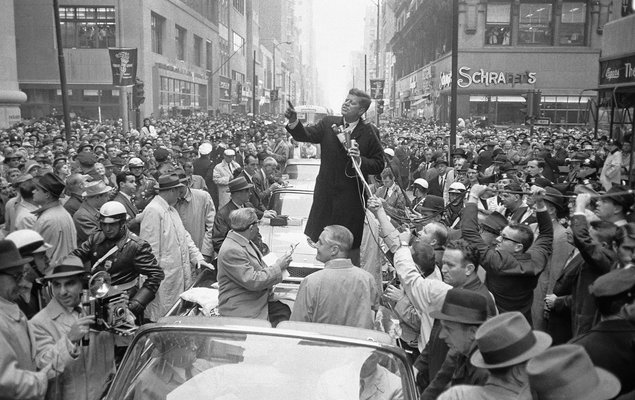
John F. Kennedy visit to Philadelphia 1960


How did we ever do it?

Economics Without The B.S.**:

[**  Double entendre intended.]


A Society That Builds Things

How did we ever get anything built without the help of EPA and OSHA?


Brave workers on the outstrecthed arm of the William Penn statue, above Philadelphia 1920s (no safety harness, hard hat, safety glasses, etc.)


Two brave construction workers stand on a steel girder above Kensington Avenue, near Lehigh Avenue, during construction of the Frankford Elevated Line. Notice the worker on the right only has one arm, he lost it during an accident at another construction site about 3 years before this photo was taken - June 10th 1919.

Sunday, January 13, 2013

Stagnation or Leadership Failure?

Economics Without The B.S.**:

[**  Double entendre intended.]


Stagnation or Failure in Leadership?

     There is much written among the academics about the U.S. entering a period of economic slow growth, as if this is something we can do nothing about and just might as well accept the status quo.
 

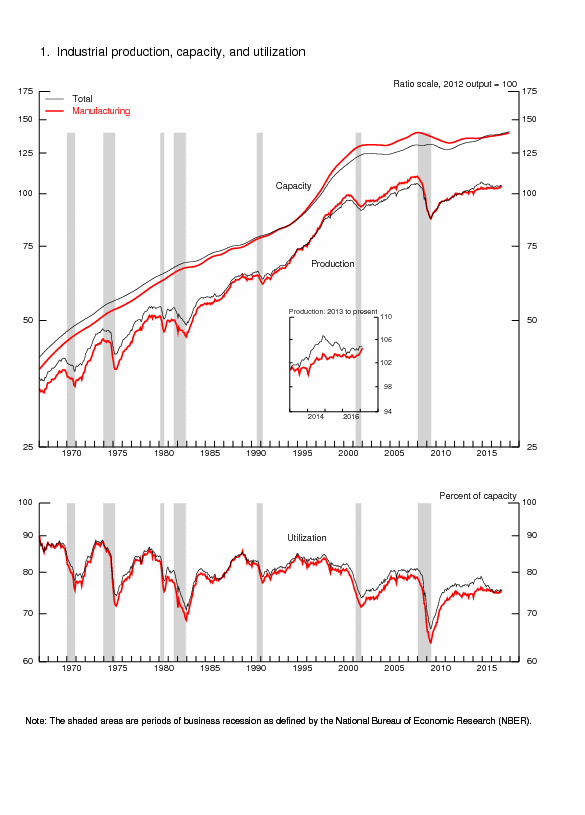
     The charts show us leveling off in our industrial capacity since 2000 and utilization below our average of over 80% (85% is considered near full capacity).
     Some 'experts' attribute this to us coming to a point in time where full resource utilization of technological breakthroughs are reaching their limit.  Or that technology improvements by way of capital investments are displacing labor inputs in productivity growth rates.  I do not accept this.  There have always been trade-offs between capital investments and labor inputs.  Sometimes one is a greater factor than the other in productivity gains.  Sometimes both contribute to the productivity gains.
     I think what these charts show is the result of decimation of the manufacturing sector of our economy (by off-shoring it) and its after effects on the rest of the economy because of the manner in which manufacturing interacts with so many other sectors of our economy.  Even if manufacturing were so productive that it now needs fewer workers for overall productivity gains, that would not account for the impact that it has in other sectors which interact with manufacturing.
     Give up your manufacturing capability and trade it for a consumer economy and this is what results -- slow growth.  Are we to accept a status quo society?  Hardly!  The leveling off we see in these charts is from a failure in leadership to inspire creativity in our economy -- like we had in the 1950's and 1960's.  We can do a lot better.  We do not have to accept this.

See my other posts with regard to leadership and manufacturing.  Also take a look at the data charts for the 1960's -- a very productive time for our economy while we ran one deficit after another and inaugurated much of our social welfare programs of today while still fighting the Vietnam War.

Friday, January 4, 2013

Thought for the day


Kenneth Clark - Civilization -- Concluding Remarks/Summation

From his thirteen part series, Civilization.  Search on You Tube.  Link to first program --

http://www.youtube.com/watch?v=PNGzoJFj9g8


Thought for the day


                                        In God's Creation,
                                             Man doth dwells.

                                        Here on Earth,
                                             Make thy home.

Casual Friday's -- Dress Code

Dress for Casual Friday's?

For me, dress for Casual Friday's was when I didn't have to wear my tin pants when I went in to brief the Boss.

Thursday, January 3, 2013

Leadership That Inspires

Economics Without The B.S.**: Leadership That Inspires

[**  Double entendre intended.]


Leadership That Inspires

Productivity drives an economy; AND, innovation drives productivity. 

Productivity is making things.  It is not asset inflation –  the value of stocks, bonds, and financial derivatives.

Today we have “experts” and knowledgeable people who will tell you the importance of human relationships, gaining somebody’s trust, confidence for a business to succeed.  While these traits are desirable, I’ll bet these “experts” never worked in a manufacturing environment, never had to make a tangible product that needed to be shipped out the door, or never had to work in a creative environment for a specific product.  When you work in a manufacturing environment it not just who you know, it’s what you know.  Your knowledge has to be based on the sciences, math, engineering, technical know-how.  This is true throughout the workplace, white-collar and blue-collar.  Emphasizing manufacturing will get us refocused on education in the sciences, math, engineering, and technology.  People educated as such will place value on scientific inquiry rather than belief systems.  These values do not get the proper emphasis in a consumer economy which is more attuned to a sales pitch, engendering warmth and relationships.  Will it take another “Sputnik” to wake us up.
And mentioning Sputnik reminds me, in our $3.8 TRILLION budget, what does NASA get…$18 billion.  Not to mention that the financial industry got bailed out in one year with several trillion dollars.  NASA hasn’t spent that in its existence in over forty years.  Do I have to listen to some cynic say, “We spent billions of dollars on space and what did we get?  Tang!”    Just what has NASA done with that $18 billion in any year? – a space station, the Mars Rover, or how about research that furthered cures for breast cancer, MRI’s and CAT scans, dialysis, artificial limbs, virtual reality.  And in forty years they have barely been able to get beyond the earth boundaries of space because of the paltry funding and lack of leadership in our society.  In the 1960’s NASA was visionary and that is why people went into the sciences, math, engineering, and technical fields.  Their discoveries affected our daily lives.  We have lost our vision.  And NASA is only one discipline that I could mention.  How about ocean exploration, at its depths, or medicine and biology?  There is so much more that we could do.  We are listening to the wrong people for leadership.  We need the inspiration that we had in the 50’s and 60’s.  When we pick up a newspaper the first page should be filled like it was in the 60’s, with rockets going into space.  The Wall Street Crowd should be relegated to the back of the paper with the Business Section and Society News.  We need to stop listening to accountants and find leaders that will turn our visionaries loose.

Burt Rutan
Burt Rutan is an aerospace engineer and entrepreneur.  He spoke on space innovation and exploration at a forum hosted by the World Affairs Council of Jacksonville and the University of North Florida.  He discussed the history of manned spaceflight and contrasted today’s space program to the pioneering days of space travel.  Rutan is the designer of “SpaceShipOne” which launched the era of commercial space travel.  He also designed the Voyager aircraft, which  became the first airplane to fly nonstop around the world without refueling in 1986.  Rutan is currently working with Microsoft co-founder Paul Allen on a new project known as the Stratolaunch. It's part airplane and part spaceship and scheduled to fly by 2016.  Rutan has some interesting comments on leadership, motivation, etc.

Today’s Federal Budget is approximately $3.5 Trillion.  The NASA part of that budget is approximately $18 Billion – less than 1% of the Federal Budget.  In 1960's NASA budget was 3% of the Federal Budget during the race to the moon.

Dr. Neil deGrasse Tyson
Dr. Neil deGrasse Tyson is Director of the Hayden Planetarium, and best-belling author and host of COSMOS.


President John F. Kennedy
At an off-the-record meeting held on November 21, 1962 with NASA Administrator James Webb, NASA Deputy Administrator Robert Seamans, and Special Assistant to the President Jerome Wiesner, President Kennedy states clearly that his administration's priority is for the United States to land on the Moon before the Soviet Union. This conversation is a part of "Listening In: The Secret White House Recordings of John F. Kennedy," available in stores now: http://bit.ly/RcGzgP
In this tape you will hear President Kennedy trying to emphasize to a bureaucrat (Mr. Webb) and his own advisor (Mr. Wiesner) the prime importance of the mission.  He is trying to light a fire under their asses so that they understand the importance of the mission.  He makes some cryptic remarks, “I don’t care about Space.  I just want to be first!”  Listen as a leader tries to motivate subordinates.


Now do you know why our economy, and society, is in the tank and nobody knows how to get it moving again?